Optimizing Supply Chain Performance



Supply chain performance measures how effectively your network moves products from suppliers to customers—balancing cost, speed, accuracy, and reliability across planning, sourcing, transportation, and fulfillment.
It shapes customer experience. When planning is accurate, suppliers deliver on time, and fulfillment runs smoothly, customers get what they want, when they want it, in good condition. When it breaks down, they experience stockouts, late deliveries, and damaged orders.
Supply chain performance directly affects your profitability. Strong performance protects margins by controlling logistics and procurement costs. It improves working capital by reducing excess inventory.
In volatile markets, a supply chain that absorbs variability is resilient. One that runs on thin margins is fragile—a single carrier delay or demand spike can trigger cascading failures.
Although many companies focus solely on freight spend, the real threat to supply chain stability is unmanaged variability. When you chase the lowest freight rates without addressing underlying volatility, you end up spending more on safety stock, expediting, and lost sales than you save.
Supply chain performance metrics and KPIs provide a clear view of how reliably, efficiently, and cost-effectively products move from origin to customer, revealing where service breaks down, costs escalate, or control is lost across the network.
Here are some key supply chain performance metrics that we recommend you track:
Supply chain performance is shaped by how well organizations manage volatile demand, align forecasts with real orders, design and update their network, secure reliable carrier capacity, maintain consistent internal processes, and integrate high-quality data so all teams operate from a single, accurate view.
Technology and outsourcing improve performance only when tightly connected to day-to-day operations. By combining integrated systems with robust supply chain analytics, teams can see how their network is actually performing and make smarter decisions about capacity, routing, and service.
A modern TMS orchestrates planning, tendering, routing, and settlement across modes. When integrated with ERP, WMS, and visibility platforms, the TMS keeps planning and execution aligned. Orders flow in, costs flow back, what’s planned is actually executable, and the entirety of the supply chain is visible.
Real-time visibility lets teams see where shipments are, when they’ll arrive, and what’s at risk before a customer complaint arrives. Exception workflows route issues to the right people with full context so they can choose the best recovery option.
A unified view of network performance enables fair comparisons. This reveals which carriers hit OTIF, where accessorials cluster, and how different nodes impact total landed cost.
Strategic partners extend your capabilities by pairing technology with specialized expertise. Instead of a black-box vendor, leading organizations engage partners who operate within their ecosystems and continuously optimize based on live performance data.
At Sheer Logistics, we believe technology alone doesn’t improve performance. Real gains come from seamless integration across systems paired with experienced operational oversight. When data flows from ERP to WMS to TMS to visibility platforms, skilled operators can continuously adjust how the network runs.
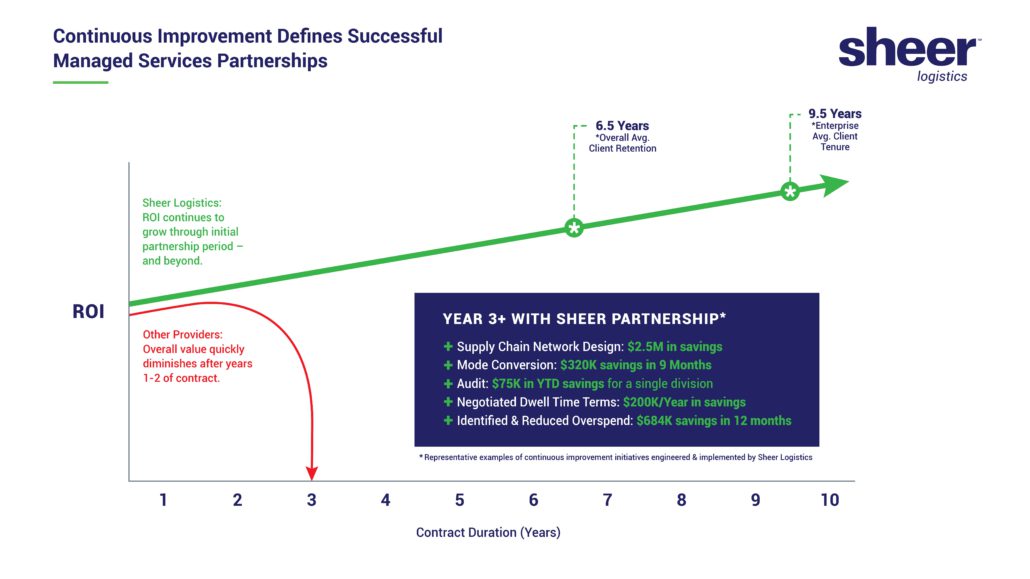
Strategies to improve supply chain performance focus on continuous optimization by establishing clear KPI baselines, standardizing processes, using real performance data to optimize modes and carriers, maintaining regular performance governance, and building contingency plans so teams can reduce variability, respond faster to disruption, and sustain long-term cost and service gains.
Before you optimize, establish a clear baseline. Define KPIs like OTIF, cost-to-serve, exception rates, and total landed cost by lane and carrier, then identify whether variability comes from carrier performance, bad forecasts, low consolidation, or chronic accessorials so you fix root causes.
When every plant, DC, and region follows the same playbook for lead times and exception handling, you eliminate noise from local workarounds and move to consistent, repeatable execution.
Use actual OTIF, cost, and service data to decide which modes and carriers serve each lane, and refresh those decisions regularly so routing doesn’t drift onto autopilot.
Build a steady cadence (weekly, monthly, quarterly) to review KPIs and agree on small, specific changes. This rhythm extends savings beyond year one and keeps your network aligned with how it actually performs.
Map single points of failure in your carrier and mode mix, pre-plan alternatives, and define escalation paths so you respond to shocks in hours, not days.
The biggest gains come from continuous optimization, not perfect network design. Teams with tight feedback loops, clear KPIs, and integrated systems build durable savings and competitive advantage over three to five years.
Supply chain performance is never really “finished.” It’s something you keep working on, not a box you check once and move on from.
When you have the visibility to see what’s happening, clear ownership for results, and the flexibility to adjust, small improvements start to stack up into real, long-term advantages.
At Sheer Logistics, we support by providing our logistics optimization that helps you achieve end-to-end transportation efficiency by combining Sheer TMS, integration via our proprietary SheerExchange integration platform, and Managed Services to streamline your logistics processes. This approach lowers costs and improves performance across every aspect of freight management.
BCG. (2025). Cost and resilience: The new supply chain challenge. https://www.bcg.com/publications/2025/cost-resilience-new-supply-chain-challenge
Mordor Intelligence. (2026). Supply chain analytics market size & share analysis. https://www.mordorintelligence.com/industry-reports/supply-chain-analytics-market
Sheer Logistics. (n.d.). Next-Gen Logistics Optimization Software Sheer Logistics. https://sheerlogistics.com/managed-transportation-services/logistics-optimization/
Sheer Logistics. (n.d.). Supply Chain Analytics: What it is, How it works, and Why it matters Sheer Logistics. https://sheerlogistics.com/blog/understanding-supply-chain-analytics/